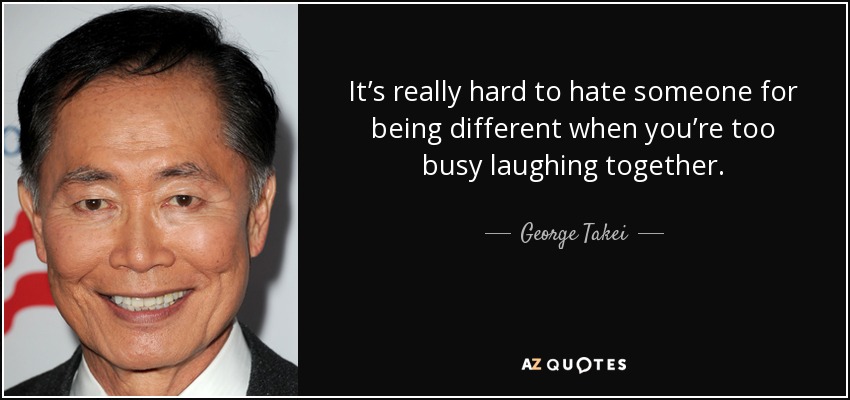
Laughter doesn’t erase systemic injustice—but it disarms the instinct to dehumanize. When George Takei said, “It’s really hard to hate someone for being different when you’re too busy laughing together,” he wasn’t offering a feel-good platitude. He was describing a tactical tool in the long war against prejudice—one he’s wielded his entire life.
Born in a Japanese American incarceration camp during World War II, bullied for his sexuality, and later thrust into the global spotlight as Star Trek’s helmsman Hikaru Sulu, Takei has spent decades turning pain into purpose. His quote isn’t just optimistic; it’s observational. It reflects a lifetime of using humor, storytelling, and shared joy to dismantle walls of fear and ignorance.
This isn’t about performative positivity. It’s about strategic humanization. And in a world where polarization spreads faster than facts, Takei’s insight holds urgent relevance.
The Psychology Behind Shared Laughter
We underestimate laughter as a social equalizer. Neurologically, laughter triggers endorphin release, lowers cortisol, and synchronizes brain activity in groups. But more importantly, it creates shared vulnerability. When we laugh together, we momentarily drop our guard. Status, identity, and ideology blur. In that gap, empathy sneaks in.
Takei understands this intuitively. His viral social media presence—equal parts activism and meme culture—relies on this dynamic. Whether he’s roasting politicians with dramatic flair or narrating absurd news clips with theatrical gravitas, he draws audiences in with humor, then delivers hard truths.
Real-world example: During a 2015 interview, Takei recounted meeting a former prison guard from the internment camp where he was held as a child. The man apologized. Takei responded not with anger, but with a story—told with humor—about how, as a boy, he’d tried to befriend the guard’s dog. The shared laugh opened space for dialogue neither expected.
This is the power Takei refers to: laughter as a backdoor to compassion.
From Internment Camps to Starfleet: A Life Shaped by Difference
George Takei’s identity is intersectional long before the term gained traction. He is: - A Japanese American who survived state-sanctioned racism - A gay man who came out publicly in 2005 after decades of silence - An actor who rose to fame in a franchise that imagined a diverse future
His lived experience fuels his message. The quote isn’t theoretical—it’s forged in real exclusion.
At age five, Takei was imprisoned with his family at the Rohwer War Relocation Center in Arkansas. Barbed wire, armed guards, and the loss of home defined his earliest memories. Yet, he has often spoken of how his parents used humor to protect their children. His mother would reframe the camp’s harsh conditions with playful nicknames. The communal toilets? “The Porcelain Palace.”
That early lesson—that joy can be an act of resistance—never left him.
Later, as Sulu, he represented visibility in sci-fi at a time when Asian leads were nearly nonexistent. But even that role had limits. His character had no backstory, no family, no romance—especially no same-sex relationships, despite Takei’s own truth.
For years, he stayed closeted, fearing career suicide. When he finally came out, he did so not with shame, but with storytelling—his signature blend of candor and humor. His Broadway musical Allegiance, co-created with Lea Salonga, dramatized the internment experience with songs that balanced sorrow and satire, proving trauma and laughter aren’t mutually exclusive.
Why Humor Disarms Hate
Hate thrives on abstraction. It’s easier to vilify “the other” when they’re a caricature. But laughter requires proximity. You can’t truly laugh with someone you see as less than human.
Takei leverages this truth. Consider his viral Facebook posts: he often pairs sharp political commentary with exaggerated facial expressions or absurd captions. A post condemning anti-LGBTQ+ legislation might feature him in a regal pose, captioned: “When they try to erase you but you’ve already written seven books.” The humor disarms, then educates.
Common mistake: Many activists avoid humor, fearing it undermines seriousness. But this misreads audience psychology. Information overload breeds fatigue. Humor creates retention.
Workflow tip: When discussing sensitive issues, open with a relatable, light anecdote. Takei often starts speeches by joking about his age or his love of social media. The audience relaxes. Then he pivots to deeper truths—like being detained by his own government or rejected by his church for loving a man.
That pivot works because of the laughter.
Laughter Without Erasure: Setting the Boundaries
This isn’t a call to laugh away oppression. Takei never suggests humor replaces policy change, legal advocacy, or reparative justice. Instead, he positions laughter as a catalyst—a way to build coalitions across difference so that harder work becomes possible.
Consider the LGBTQ+ rights movement. Before marriage equality became law, it was The Ellen DeGeneres Show—a platform built on warmth and humor—that normalized gay identity for millions of Americans. Comedy Central roasts, Will & Grace, and Queer Eye didn’t pass legislation. But they shifted culture. They made it harder for people to hate what they saw as part of their living room.
Takei’s activism follows this model. His 2019 graphic novel They Called Us Enemy educates young readers about Japanese internment—but it’s also illustrated with expressive, almost cartoonish art that makes the trauma accessible without diluting it.
Limitation to acknowledge: Humor can backfire if it punches down or mocks marginalized experiences. The key is shared laughter, not laughter at. Takei’s humor targets power structures, hypocrisy, and absurdity—not victims.
Unity in Action: Modern Applications of Takei’s Philosophy
How do we apply this beyond inspirational quotes?
- Workplace DEI Initiatives
- Too many diversity trainings feel punitive. They focus on compliance, not connection. Imagine reframing them around storytelling circles where employees share personal, humorous experiences of cultural misunderstanding. Laughter doesn’t erase bias—but it builds relationships that make accountability easier.
- Community Dialogues on Polarizing Issues
- In divided towns, bring people together not for debate, but for improv games or comedy workshops. Shared play reduces defensiveness. Organizations like The Theater of the Relatively Oppressed use this model to bridge racial and economic divides.
- Digital Activism
- Takei dominates social media not by shouting, but by engaging. He replies to trolls with wit, not rage. When someone told him to “go back to Japan,” he responded, “I was born in California—but thanks for reminding me to vote!” The post got 50K shares. Humor turned bigotry into a teachable moment.

Use case: A school in Texas used Takei’s quote to launch a “Laugh to Connect” week. Students shared cultural jokes, performed skits, and created memes about inclusion. Teachers reported fewer incidents of bullying the following month.
The Star Trek Legacy: Where Vision Meets Reality
Star Trek was radical in the 1960s—a multiracial crew exploring the cosmos as equals. Takei’s Sulu was groundbreaking, even if underdeveloped. Today, the franchise continues evolving, with openly LGBTQ+ characters like Adira Tal and Paul Stamets.
But the deeper message isn’t just representation—it’s collaboration. The Enterprise crew doesn’t just tolerate difference; they rely on it. Spock’s logic, Uhura’s communication, McCoy’s empathy—each is essential.
Takei’s quote echoes this ethos: unity isn’t the absence of difference. It’s the celebration of it—especially through shared joy.
He’s carried that vision off-screen, co-founding the Japanese American National Museum and advocating for LGBTQ+ rights with the same energy he brings to Star Trek conventions.
When he walks onto a panel stage in a flamboyant jacket, flashing his signature “Oh Myyy” grin, he’s not just entertaining. He’s modeling a world where identity is worn with pride, and laughter is a radical act of inclusion.
Closing: How to Live the Quote Every Day
George Takei’s wisdom isn’t reserved for activists or celebrities. You can apply it tomorrow.
- At work: Invite a colleague you rarely connect with to lunch—and challenge each other to tell your most embarrassing professional story.
- At home: Watch a comedy special from a culture not your own. Laugh, then ask: What does this teach me about their world?
- Online: Share a funny, humanizing post that challenges stereotypes. Use humor to reframe narratives.
Hate depends on distance. Laughter collapses it.
Takei didn’t survive internment, homophobia, and erasure by being solemn. He did it with resilience, storytelling, and yes—laughter. Not as escape, but as strategy.
Start small. Share a joke. Listen to one. Let the moment linger. And when that common humanity surfaces, hold onto it. That’s where change begins.
FAQ
What does George Takei’s quote about laughter mean? It means shared joy breaks down barriers of fear and prejudice, making it harder to dehumanize people who are different from us.
Why is George Takei a prominent LGBTQ+ activist? He came out publicly in 2005 and has since advocated for marriage equality, LGBTQ+ visibility, and civil rights, using his platform to educate and inspire.
How did George Takei experience discrimination? As a child, he was imprisoned in a U.S. government internment camp during WWII. As a gay man, he faced societal and professional pressure to stay closeted for decades.
What role did humor play in George Takei’s activism? Humor makes his messages accessible, disarms critics, and fosters connection—helping audiences engage with difficult topics like racism and homophobia.
How can laughter promote diversity and inclusion? Shared laughter builds trust and empathy, creating emotional bridges between people of different backgrounds.
Is George Takei still involved in Star Trek? Yes, he remains a beloved figure in the franchise, attending events, lending his voice to projects, and supporting new generations of cast members.
What can individuals do to apply this lesson in daily life? Seek out shared moments of joy with people different from you—through stories, comedy, or lighthearted conversations that humanize both sides.
FAQ
What should you look for in George Takei’s Quote of the Day: Laughter as a Bridge to Unity? Focus on relevance, practical value, and how well the solution matches real user intent.
Is George Takei’s Quote of the Day: Laughter as a Bridge to Unity suitable for beginners? That depends on the workflow, but a clear step-by-step approach usually makes it easier to start.
How do you compare options around George Takei’s Quote of the Day: Laughter as a Bridge to Unity? Compare features, trust signals, limitations, pricing, and ease of implementation.
What mistakes should you avoid? Avoid generic choices, weak validation, and decisions based only on marketing claims.
What is the next best step? Shortlist the most relevant options, validate them quickly, and refine from real-world results.


:max_bytes(150000):strip_icc():focal(801x261:803x263)/Matthew-Lillard-paramount-event-102425-a13882f0fc524685bbb840985e4e9563.jpg)